

By : Guardian Nigeria | Date: 18 March 2026 4:34am WAT
My rejoinder to this article which is available here : https://guardian.ng/news/faulty-design-vandalism-neglect-endanger-3-4b-rail-overhaul/
By Rowland Ataguba
An interesting report but with some material inaccuracies.
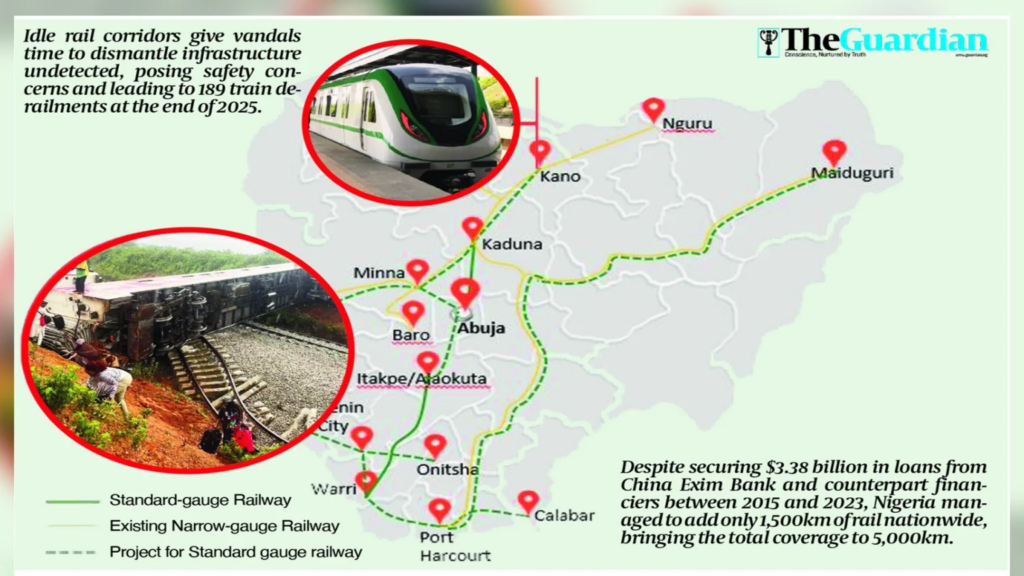
First some points of correction. Nigeria has not added 1,500km to its rail network since 2015 as alleged and the railway modernisation project began in earnest in 2006 with Obasanjo’s award of the Lagos-Kano SGR for $8.3bn, not $2.3bn in 2015 by Buhari. When the Kano to Maradi and Dutse, and Kano to Kaduna SGR projects are completed in the next few years, assuming no further hiccups as only we are able to conjure, then we would have only covered a total distance of about 760 km (or about 1,173 track km) since 2015.
The Coastal railway project between Lagos and Calabar was actually awarded in 2014 for over $12bn and then renegotiated to $11.17 in 2019. Not that it made much difference to its commencement as it has remained in the doldrums with a shovel yet to hit the ground after over 10 years hence.
Furthermore, the actual spend on the modernisation projects is higher than given in the report. Abuja – Kaduna for instance came in a tard over $1bn, not $836m and Lagos – Ibadan and Kaduna – Kano have and are certainly coming in above $2bn each, not $1.2bn and $1.3bn respectively. As far as the Abuja Light Rail is concerned, only 70 per cent of the original scope (45km of 61km) was built for about the original price ($820m).
It is indeed difficult to accept that the costs at completion represent fair value when compared to say the TAZARA which was built by the same Chinese company many years ago. Other recent completions in Africa like Nairobi-Mombasa or Addis Ababa-Djibouti would appear to have turned out similarly higher than should be the case. It has been suggested that opacity in procurement and the lack of competition may be contributory to the relatively high cost of Chinese railway contracts in Africa but at least they get built.
I agree with Abiodun Otunola that the NRC’s emphasis on passenger rail is misplaced and unsustainable. It must however be understood that rail infrastructure is a sunk cost which is seldom recoverable save for where concerns bulk mineral haulage. Notwithstanding, the operating cost (opex) should be recoverable as much as possible.
Where we fail in Nigeria nay Africa is with the business model largely because the NRC as a government agency, is not sufficiently commercially driven and customer focused to compete with a dynamic privately run roads sector. It is also conflicted as it is self regulating. There is certainly a case for the contiguity of infrastructure over long distances where rail is competitive, so there is merit in connecting Ibadan to Abuja, and Itakpe to Abuja. A dual gauge connection between Baro and Minna is also desirable.
These would close out what you may call the first wave of the modernisation projects which should provide clear paths from Lagos to Maradi and Warri to Maradi in standard gauge. We could also designate the legacy narrow gauge corridors of Port Harcourt to Kaduna and Maiduguri as well as Lagos to Nguru with their branch lines as Sustainability railway projects. These could be concessioned as freight only railways with transhipment points at key locations such as Rigachikun, Oturkpo, Minna etc.
All said, railway operations is where Nigeria’s rail challenge lie the most and it is only by encouraging the participation of private operators that our railway performance can be optimised. Dr Banjo is right on the money and echoes what has been repeatedly stated in terms of misaligned priorities, and the insufficiency or absence of project feasibility as well as data transparency.
The Bureau of Statistics data presented is heart breaking and corroborates what Otunola and Banjo are saying, that our railway is not impacting the logistics chain. For a country of such distances and population, there is no gainsaying that we are not well served by rail.
The Nigerian network is relatively small at 4,200 track km for a population of 220m people with a land mass of 910,000 sq km, implying very low capacity. When you look at the useful measures of how the railways serve the population, such as our rail density of 4.61 rail km per thousand square km or our rail per population ratio of 19 km of railway km per million persons.
Measures of utilisation and efficiency such as train density in terms of number of trains per day and traffic density in terms of net tonne km and passenger km per km of track per year, they tell us patently that we are yet to achieve the capacities required for a sustainable railway. The recent news of a solitary trip in one direction per day on Ujevwu – Itakpe is perhaps best indicative of how dire our situation is.
Comparatively only South Africa and the Arab Maghreb including Egypt reflect tangible rail statistics of sorts in Africa. Whereas South Africa has a rail density of 17.5 km per ‘000 sq km and rail per population of 323 km per million persons. Egypt has rail density of 5.1 km and rail per population of 43 km per mill. Sudan has a rail density of 3.8 km and rail per population of 138 km per mill.
Cote d’Ivoire has a rail density of 2 km per ‘000 sq km and rail per population of 21 km per mill. Ghana has rail density of 5 km and rail per population of 35km per mill. Kenya has rail density of 4.8km per ‘000 sq km and rail per population of 50km while Tanzania has rail density of 4.2km per ‘000 sq km and rail per population of 58km per mill.
Africa needs to do a lot to build up its network and thankfully this is happening albeit slowly. In contrast the UK has a rail density of 65 km per ‘000 sq km and a rail per population of 230 km per mill. China has a rail density of 17.5 km per ‘000 sq km and rail per population of 118 km. India has rail density of 41km per ‘000 sq km and rail per population of 93 km per million.